
LLM Guardrails in Practice: What Actually Works
Control the risk, not just the model.
LLMs are unpredictable. They hallucinate, leak data, generate harmful content, or refuse legitimate requests. Guardrails constrain model behavior without sacrificing capability.
The key is knowing which guardrails matter and which are just noise.
Guardrails aren’t about controlling the model. They’re about controlling the risk.
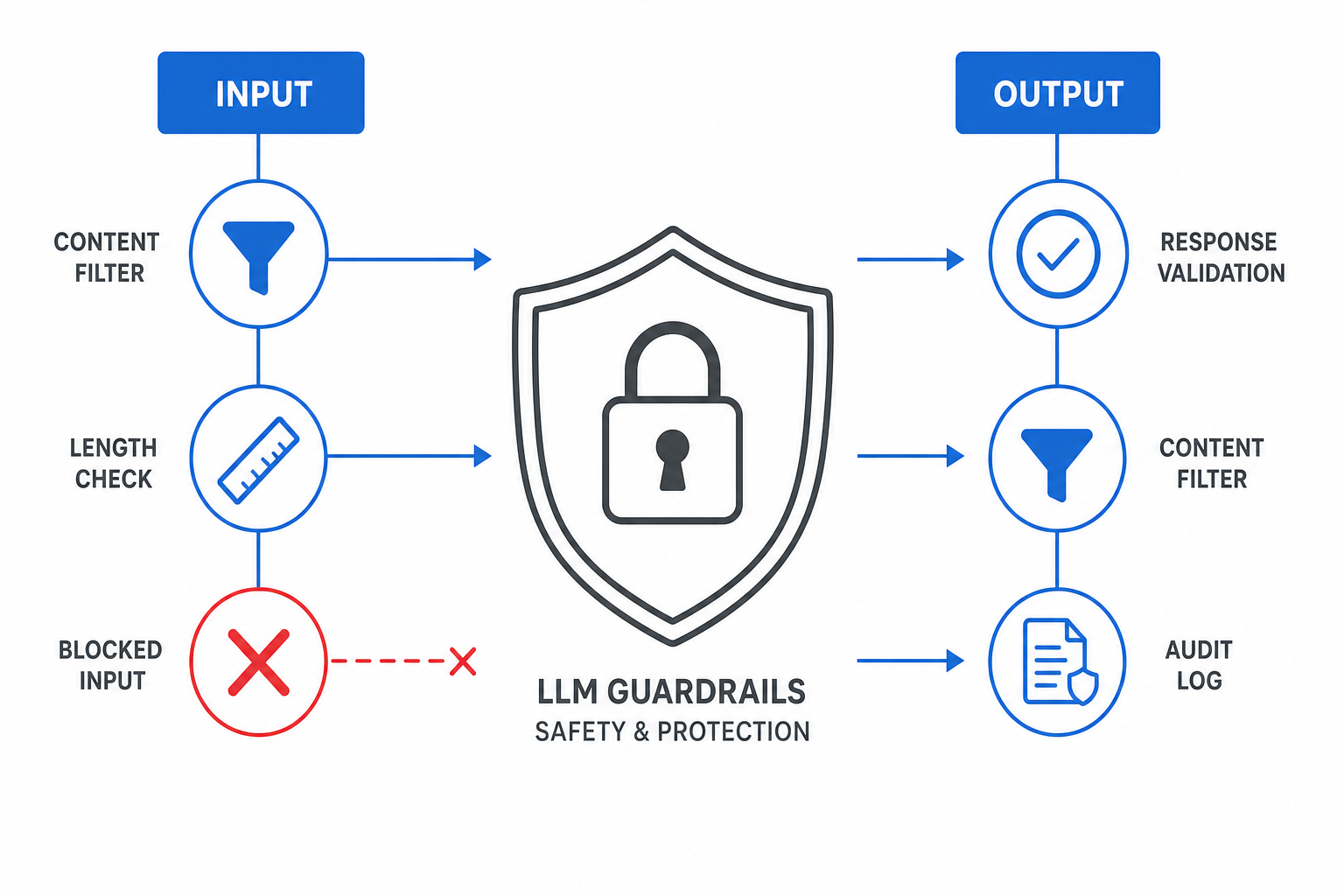
Input validation
The most important guardrail. Bad input gets bad output, and bad input can also prompt-inject your system.
Strategy 1: Prompt Sanitization
Sanitize dangerous patterns early:
import re

class PromptSanitizer:
    def __init__(self):
        self.dangerous_patterns = [
            r"ignore\s+previous\s+instructions",
            r"system\s+prompt",
            r"you\s+are\s+now\s+free",
            r"break\s+out\s+of",
        ]

    def sanitize(self, prompt: str) -> str:
        for pattern in self.dangerous_patterns:
            prompt = re.sub(pattern, "[REDACTED]", prompt, flags=re.IGNORECASE)
        return prompt
This isn’t bulletproof. Adversarial inputs are creative. But it catches the obvious ones, and the obvious ones are the most common.
Strategy 2: Input Length Limits
Length limits prevent token waste and timeouts:
class InputValidator:
    def __init__(self, max_length: int = 10000):
        self.max_length = max_length

    def validate(self, prompt: str) -> tuple[bool, str]:
        if len(prompt) > self.max_length:
            return False, f"Input too long: {len(prompt)} > {self.max_length}"
        return True, "OK"
Strategy 3: Content Filtering
Content filtering blocks policy violations. The patterns here depend on your domain:
class ContentFilter:
    def __init__(self):
        self.blocked_topics = [
            "violence", "hate speech", "self-harm",
            "sexual content", "illegal activities",
        ]

    def filter(self, prompt: str) -> tuple[bool, str]:
        prompt_lower = prompt.lower()
        for topic in self.blocked_topics:
            if topic in prompt_lower:
                return False, f"Blocked: {topic}"
        return True, "OK"
Simple string matching is fast but imprecise. For production, use a classifier model — even a small one like qwen3-1.7b — to detect policy violations. It’s more accurate and harder to evade.
Output filtering
The model’s output needs checking too. Structure, content, and facts.
Strategy 1: Response Validation
Validate structure first. If you expect JSON, check for JSON:
class ResponseValidator:
    def __init__(self):
        self.required_fields = ["answer", "confidence"]

    def validate(self, response: dict) -> tuple[bool, str]:
        for field in self.required_fields:
            if field not in response:
                return False, f"Missing field: {field}"
        return True, "OK"
Strategy 2: Content Filtering
Filter harmful content:
class OutputFilter:
    def __init__(self):
        self.blocked_patterns = [
            r"kill\s+someone",
            r"bomb\s+recipe",
            r"hate\s+speech",
            r"self-harm",
        ]

    def filter(self, response: str) -> tuple[bool, str]:
        for pattern in self.blocked_patterns:
            if re.search(pattern, response, re.IGNORECASE):
                return False, f"Blocked: {pattern}"
        return True, "OK"
Strategy 3: Fact-Checking
Fact-checking is harder. You can’t validate every claim, so pick the ones that matter:
class FactChecker:
    def __init__(self):
        self.known_facts = {
            "capital of france": "Paris",
            "population of usa": "330 million",
            "speed of light": "299,792,458 m/s",
        }

    def check(self, claim: str) -> tuple[bool, str]:
        claim_lower = claim.lower()
        for fact, truth in self.known_facts.items():
            if fact in claim_lower and truth not in claim_lower:
                return False, f"Fact check failed: {fact}"
        return True, "OK"
For real fact-checking, you need a retrieval pipeline. Check claims against a knowledge base, not a hardcoded dictionary.
Safety mechanisms
Strategy 1: Rate Limiting
Rate limiting prevents abuse:
import time
from collections import deque

class RateLimiter:
    def __init__(self, max_requests: int = 10, window: int = 60):
        self.max_requests = max_requests
        self.window = window
        self.requests = deque()

    def allow(self) -> bool:
        now = time.time()
        while self.requests and self.requests[0] < now - self.window:
            self.requests.popleft()

        if len(self.requests) >= self.max_requests:
            return False

        self.requests.append(now)
        return True
Strategy 2: Token Budgeting
Token budgeting caps per-request costs:
class TokenBudget:
    def __init__(self, max_tokens: int = 1000):
        self.max_tokens = max_tokens

    def validate(self, response: str) -> tuple[bool, str]:
        token_count = len(response.split())
        if token_count > self.max_tokens:
            return False, f"Token limit exceeded: {token_count} > {self.max_tokens}"
        return True, "OK"
Strategy 3: Context Window Management
Context window management prevents overflow:
class ContextManager:
    def __init__(self, max_context: int = 4096):
        self.max_context = max_context
        self.context = []

    def add(self, message: str):
        self.context.append(message)
        self.trim()

    def trim(self):
        while len(" ".join(self.context)) > self.max_context:
            self.context.pop(0)
Sliding window trimming is simple but loses early context. Better approaches use summarization or attention-based compression, but those add latency.
Compliance
Enterprise systems need compliance guardrails. Two that matter most:
Pattern 1: Data Residency
Data residency — ensure data stays within required geographic boundaries:
class DataResidency:
    def __init__(self, allowed_regions: list[str]):
        self.allowed_regions = allowed_regions

    def validate(self, region: str) -> tuple[bool, str]:
        if region not in self.allowed_regions:
            return False, f"Region not allowed: {region}"
        return True, "OK"
Pattern 2: Audit Logging
Audit logging — log all model interactions:
import json
from datetime import datetime

class AuditLogger:
    def __init__(self, log_file: str = "audit.log"):
        self.log_file = log_file

    def log(self, request: dict, response: dict):
        entry = {
            "timestamp": datetime.now().isoformat(),
            "request": request,
            "response": response,
        }
        with open(self.log_file, "a") as f:
            f.write(json.dumps(entry) + "\n")
Audit logs are critical for debugging and compliance. Make them structured, append-only, and stored securely.
Putting it together
Pattern 1: Simple Guardrails
A simple guardrail pipeline:
class SimpleGuardrails:
    def __init__(self):
        self.input_validator = InputValidator(max_length=10000)
        self.output_filter = OutputFilter()

    def process(self, prompt: str) -> str:
        valid, message = self.input_validator.validate(prompt)
        if not valid:
            return f"Error: {message}"

        response = self.call_model(prompt)

        valid, message = self.output_filter.filter(response)
        if not valid:
            return f"Error: {message}"

        return response
Pattern 2: Advanced Guardrails
Advanced guardrails add sanitization, rate limiting, and token budgets:
class AdvancedGuardrails:
    def __init__(self):
        self.sanitizer = PromptSanitizer()
        self.input_validator = InputValidator(max_length=10000)
        self.content_filter = ContentFilter()
        self.output_filter = OutputFilter()
        self.rate_limiter = RateLimiter(max_requests=10)
        self.token_budget = TokenBudget(max_tokens=1000)

    def process(self, prompt: str) -> str:
        prompt = self.sanitizer.sanitize(prompt)

        valid, message = self.input_validator.validate(prompt)
        if not valid:
            return f"Error: {message}"

        valid, message = self.content_filter.filter(prompt)
        if not valid:
            return f"Error: {message}"

        if not self.rate_limiter.allow():
            return "Error: Rate limit exceeded"

        response = self.call_model(prompt)

        valid, message = self.output_filter.filter(response)
        if not valid:
            return f"Error: {message}"

        valid, message = self.token_budget.validate(response)
        if not valid:
            return f"Error: {message}"

        return response
When guardrails matter
Guardrails matter when you’re building user-facing systems, handling sensitive data, or running in production. They also matter when you have compliance requirements — GDPR, HIPAA, SOC 2.
They don’t matter when you’re prototyping, using models for internal tools only, or not handling sensitive data. Skip them until you need them.
The tradeoff is always capability versus safety. More guardrails mean fewer failures but also fewer capabilities. Find the balance that works for your system.
Guardrails cover the model conversation, but they stop at the point where an agent calls a tool or hands work to another agent. Once you deploy MCP tools or A2A agents, you also need protocol security — identity, scoped authorization, delegation limits, and audit trails for who may act on whose behalf. That layer is covered in A2A and MCP Agent Security: Identity, Delegation, and Audit Trails.
Tradeoffs
| Strategy | Safety | Capability | Latency |
|---|---|---|---|
| No guardrails | Lowest | Highest | Lowest |
| Input validation | High | Medium | Low |
| Output filtering | High | Medium | Low |
| Safety mechanisms | Highest | Lowest | Highest |
| Compliance | Highest | Lowest | Highest |
Related
- Model Routing Strategies — capability-based, cost-aware, latency-aware routing
- Cost Optimization for LLM Systems — token budgeting, fallback models, caching
- Multi-Model System Design — architecture for multiple models
- LLM Architecture — system design pillar: routing, cost, guardrails, and orchestration
