
Self-Hosted SEO Tools and Platforms: Open Source Guide
Open-source SEO beyond WordPress plugins
Self-hosted SEO now covers crawlers, Search Console dashboards, rank trackers, MCP servers, and local AI. This guide compares the main open-source platforms and which features work without paid SEO APIs.
The term covers very different systems. Some projects work from your own website and first-party search data alone, while others self-host the interface but still require DataForSEO, a commercial SERP provider, or another paid API for their most valuable features.
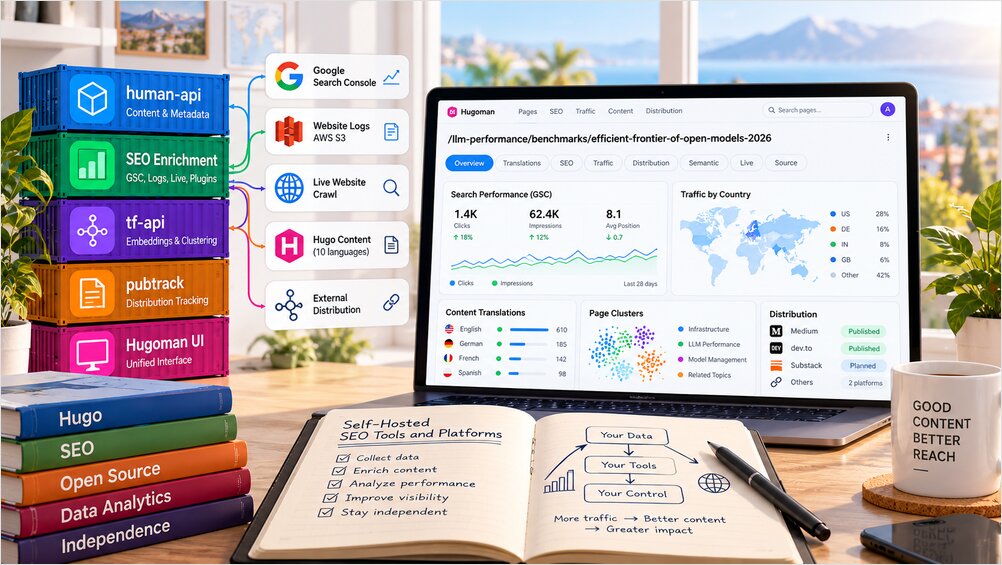
A dashboard wrapped around a paid data service is architecturally different from a crawler, a Search Console analyzer, or a local AI system that keeps working when every commercial API key is removed. That difference, not the location of the source code, decides which platforms fit a no-paid-API stack, and it is the axis of the comparison below. These systems run alongside deploy pipelines and indexing signals - the publishing infrastructure mapped in the Web Infrastructure hub of this site. They sit beside, not inside, the CMS: for the metadata, schema, and sitemap layer generated by WordPress plugins - including local-LLM options - the WordPress SEO plugins comparison covers that layer separately.
What Is a Self-Hosted SEO Platform?
A self-hosted SEO platform runs at least the application layer on infrastructure you control. Depending on the project, the application crawls websites, analyzes Search Console data, tracks rankings, inspects Core Web Vitals, generates reports, or exposes SEO functions to AI agents.
The question that separates the projects is where the data comes from. A typical commercial SEO platform combines several expensive datasets:
keyword database
+
SERP collection
+
backlink crawler
+
site crawler
+
Search Console
+
analytics
+
content analysis
Open-source projects reproduce some of these layers well. Site crawling, technical SEO, Search Console analysis, local page analysis, Core Web Vitals, and LLM-assisted recommendations are all practical to self-host.
Other layers are much harder. A global backlink index requires continuously crawling a substantial part of the public web, and reliable worldwide keyword-volume and SERP datasets require either large-scale data collection or access to commercial sources. Open-source projects that promise Ahrefs-like data usually obtain at least part of it from another API.
Four Types of Self-Hosted SEO Tool
The current ecosystem separates into four categories.
Technical crawlers
These inspect the actual website and detect broken links, duplicate titles, missing metadata, canonical errors, heading problems, redirect chains, and accessibility issues.
Examples:
They normally provide substantial value without any paid SEO API.
Search performance and monitoring platforms
These combine crawl data with first-party search information, particularly Google Search Console.
Examples:
For an established website, this category is often more useful than a generic keyword database because it works with real impressions, clicks, CTR, rankings, and the pages Google already associates with your domain.
Rank and SERP tools
These collect search engine results and track positions.
Examples:
The difficulty here is operational rather than conceptual. Search engines rate-limit automated access, change markup, present CAPTCHAs, and personalize results. A self-hosted SERP system can work, but it requires more maintenance than calling a commercial SERP API.
Full SEO platforms
These attempt to bring keyword research, backlinks, competitor analysis, site audits, rank tracking, and AI workflows into one product. The most visible example is OpenSEO. These systems provide an attractive interface, and their external data often still comes from commercial APIs, so inspect the data path before deployment.
Self-Hosted SEO Tools Compared
GitHub star and fork counts are approximate snapshots from September 2026. They are adoption signals, not quality scores.
| System | Type | GitHub stars | Forks | Web UI | CLI | MCP | Local LLM | Paid SEO API needed for core value | License |
|---|---|---|---|---|---|---|---|---|---|
| OpenSEO | Full SEO platform | 20.5K | 2.6K | Yes | Partial | Yes | Not primary | Yes, DataForSEO | MIT |
| SerpBear | Rank tracker | 2.1K | 294 | Yes | No | No | No | No, if using own proxies | MIT |
| LibreCrawl | Technical crawler | 980 | 206 | Yes | Limited | No | No | No | MIT |
| SiteOne Crawler | Technical crawler / QA | 917 | 84 | Reports / desktop | Yes | No native | Yes | No | MIT |
| CrawlSEO | Monitoring platform | 601 | 92 | Yes | No | Yes | Agent-side | No | MIT |
| SEO Skill | SEO CLI / agent backend | 532 | 42 | No | Yes | Yes | Agent-side | No | Apache-2.0 |
| Scouter | AI-native crawler | 71 | 7 | Yes | Some | Yes | Yes | No | MIT |
| OpenGSC | GSC platform | 27 | 19 | Yes | Limited | Yes | Yes | No for core | MIT |
| OpenSERP | SERP API / CLI | Varies | Varies | API docs | Yes | Add-on | No | No | MIT |
The most important column is whether useful functionality survives when commercial SEO API keys are removed. OpenSEO’s 20,000 stars reflect broad appeal and an all-in-one proposition, not self-containment, and a young project such as Scouter can offer a more interesting local-LLM architecture with far fewer stars. Before choosing, it is better to ask:
Does the project solve my problem?
Does its core still work without a paid API?
Can I export my data?
Can I automate it?
Is the project maintained?
Can I replace individual components later?
OpenSEO
OpenSEO is the largest project in this comparison, with roughly 20.5 thousand GitHub stars and 2.6 thousand forks at the time of writing. The project describes itself as an open-source alternative to Semrush and Ahrefs and provides keyword research, rank tracking, competitor intelligence, backlinks, site audits, AI visibility, MCP, and agent skills.
Its strongest feature is product integration: a modern application with project context, SEO workflows, and an MCP interface for clients such as Claude Code, Codex, OpenClaw, and Hermes, instead of assembling several command-line utilities.
The data dependency is the other half of the picture. The project documentation explicitly requires a DataForSEO API key for SEO data, and DataForSEO is a separate pay-as-you-go commercial service. Self-hosting OpenSEO does not self-host the underlying dataset. The architecture is:
If you already use DataForSEO, OpenSEO is an open-source control plane around it, and self-hosting still gives you control over projects, credentials, application state, and agent integration. It is not a replacement for paid external SEO data.
Best use
Choose OpenSEO when you want a modern Semrush-style interface and are comfortable paying DataForSEO directly instead of paying for a traditional SEO SaaS subscription. Do not choose it if the requirement is that the system retains most of its value with no paid SEO API at all.
SiteOne Crawler
SiteOne Crawler is one of the most self-contained tools in the list. It has around 917 GitHub stars and 84 forks and is designed as a cross-platform website crawler for SEO, security, accessibility, performance, and quality assurance.
The SEO checks cover the technical layer: metadata, links, redirects, page structure, status codes, sitemaps, and related issues. SiteOne also inspects security headers, TLS, accessibility, caching, and performance, which makes it useful for developer-managed websites where SEO is part of a wider deployment-quality process.
Browser rendering for modern sites
SiteOne can optionally render pages through Chromium using the Chrome DevTools Protocol. That matters for React, Vue, Angular, and other sites where important links or content only appear after JavaScript execution. For static systems such as Hugo, browser rendering is usually unnecessary, but it is useful when testing embedded applications, client-side widgets, or pages with significant JavaScript behavior.
Local LLM support
SiteOne’s optional AI layer supports OpenAI, Anthropic, Gemini, and arbitrary OpenAI-compatible endpoints. The OpenAI-compatible path can point at Ollama, vLLM, LocalAI, self-hosted gateways, or other compatible servers, so a local model can inspect selected pages without sending content to a cloud provider.
A fully local architecture:
SiteOne determines facts such as missing descriptions or broken links, while the model proposes better wording or summarizes the findings.
CI/CD quality gate
A practical workflow:
The crawl runs against a local preview before deploy, and the pipeline fails on critical issues. That gives engineering teams an automated check instead of a dashboard that is reviewed occasionally.
Best use
Choose SiteOne for technical websites, static-site generators, CI/CD pipelines, or any environment where SEO checks should behave like automated software-quality checks. It is a strong option when the priority is genuine local value rather than external SEO datasets.
LibreCrawl
LibreCrawl is a web-based multi-user SEO crawler with around 980 GitHub stars and 206 forks. The project positions it as an open-source alternative to desktop crawlers such as Screaming Frog.
LibreCrawl extracts page titles, descriptions, headings, links, response information, and other technical SEO data. It supports JavaScript rendering, configurable crawl depth, URL filtering, proxies, robots.txt behavior, and exports to CSV, XLSX, JSON, and XML. Unlike a desktop-only crawler, it runs as a web application and supports concurrent users with separate sessions.
External dependencies
The core crawler works locally. PageSpeed Insights integration can use Google’s API and benefits from an API key for higher limits, but the crawler itself does not require a commercial SEO data service.
Because LibreCrawl operates against the rendered website rather than the CMS, it works with:
Hugo
WordPress
Ghost
Drupal
Next.js
Astro
React
custom websites
Limitations
LibreCrawl does not offer the agent-oriented architecture of Scouter or SEO Skill: there is no central MCP workflow, and local LLM integration is not its main focus. Its strength is straightforward crawling and data export.
Best use
Choose LibreCrawl when you want a browser-based, open-source crawler with a familiar human workflow and good export support.
Scouter
Scouter is a younger project, but its architecture is the most ambitious in this list for AI-native SEO workflows. It has roughly 71 GitHub stars and 7 forks, so its deployment history is tiny compared with OpenSEO or SerpBear. The documented feature set includes a self-hosted web UI, multi-user support, JavaScript rendering, internal PageRank, custom XPath and regex extractors, SQL access to crawl data, AI page categorization, AI bulk generation, and a native MCP server.
Bring your own LLM
Scouter supports hosted and local models; the documented local options are Ollama and vLLM. The resulting architecture:
This is closer to an “SEO database for agents” than to a traditional crawler.
MCP integration
Without MCP, an AI assistant usually needs reports pasted into its context or custom scripts written around exported files. With MCP, the agent asks the SEO system directly for structured crawl evidence, triggers operations, and retrieves relevant findings as needed. Workflows such as this become realistic:
Find pages with weak internal linking.

For each page:
- show inlink count
- identify semantically related pages
- propose links
- do not modify content
The crawler supplies the facts, the model provides the interpretation.
Limitations
Scouter is new. A 2026 project with around 60 commits and a small user base is promising infrastructure rather than a proven production standard, and its more complex stack means more operational components than a single-binary crawler such as SiteOne.
Best use
Choose Scouter when MCP, multi-user web access, SQL over crawl data, and local AI integration are important enough to justify running a younger platform.
SEO Skill (iannuttall/seo)
SEO Skill takes a different approach: instead of a large browser dashboard, it provides a local seo CLI, a TypeScript library, a packaged agent skill, and an MCP server. The project has around 532 GitHub stars and 42 forks.
The workflow combines evidence from your own crawl, Google Search Console, and optional analytics into reports that humans or AI agents can inspect and act upon. Useful commands:
seo report
seo quick-wins
seo second-page
seo technical-watch
seo refresh-priorities
seo report --json
seo mcp serve
The project exposes more than 70 SEO audit tools through its CLI and MCP layer.
First-party data first
SEO Skill treats paid research providers as optional enrichment rather than mandatory infrastructure. It can use local crawl data, Google Search Console, and analytics data, and it can optionally connect to DataForSEO, Semrush, or Ahrefs. If none of the commercial providers are configured, the first-party workflow still works.
For an established website, a query with
8,000 impressions
average position 8.2
CTR 1.1%
describes your actual opportunity, while a third-party estimate claiming that a related keyword receives 12,000 searches per month describes a market you cannot verify from your own data.
Agent architecture
The LLM receives structured evidence from the SEO tool instead of scraping dashboards or guessing metrics.
Limitations
SEO Skill is not a polished multi-user SEO dashboard. If you want a visual application that marketing staff can browse all day, another system may fit better. External competitor, backlink, and keyword research remains limited unless optional third-party providers are added.
Best use
Choose SEO Skill when you want an agent-first, scriptable SEO backend built around first-party evidence rather than a large GUI. For developers, static-site publishers, and automated Git workflows, it is a strong fit.
CrawlSEO
CrawlSEO is a self-hosted SEO monitoring dashboard with around 601 GitHub stars and 92 forks. It combines Google Search Console, a site crawler, Core Web Vitals, SEO opportunities, and MCP access, which puts it between a crawler and a full SEO platform.
The core data sources are:
- Google Search Console
- local site crawling
- Core Web Vitals / PageSpeed data
- stored historical observations
CrawlSEO can provide ongoing monitoring without a paid SEO provider.
Optional external research
CrawlSEO can integrate with DataForSEO for keyword research and backlink information, but those features are optional, and Google Autocomplete provides a free fallback for keyword suggestions. The core stack runs without an external SEO dataset:
GSC
+
crawler
+
Core Web Vitals
+
MCP
MCP tools
CrawlSEO exposes ten MCP tools covering sites, site overview, keywords, pages, traffic, crawling, crawl issues, Core Web Vitals, and opportunities. An agent can ask questions such as:
Which pages lost impressions this month and also have technical crawl issues?
That correlation between search performance and technical state is more actionable than a generic SEO score.
Best use
Choose CrawlSEO if you want a persistent self-hosted dashboard built around Search Console and ongoing monitoring rather than one-off audits. It is particularly suitable for established sites that already receive meaningful Google search impressions.
OpenGSC
OpenGSC is another Search Console-centered platform. It is a young project, with roughly 27 stars and 19 forks, but it has accumulated a substantial feature set. The core proposition: Search Console contains valuable first-party SEO data, but Google’s own interface is limited for longitudinal analysis, cross-site monitoring, content-decay detection, and agent workflows.
OpenGSC adds:
- multi-site GSC dashboards
- rank tracking from first-party data
- striking-distance queries
- content-decay detection
- cannibalization analysis
- site auditing
- indexing tools
- alerts and digests
- MCP
- optional AI SEO tools
Built-in site audit
The crawler operates with zero external SEO APIs and checks up to hundreds of pages for broken internal links, title issues, missing descriptions, H1 problems, noindex pages, canonical mismatches, thin content, missing image alt text, and slow responses. The platform retains useful local functionality even when its optional research integrations are disabled.
AI and external providers
OpenGSC supports multiple AI providers and custom OpenAI-compatible endpoints, which makes local inference possible depending on the configured server. Some extended research features can use DataForSEO or other external providers, but they are not required for the Search Console dashboard and local audit layer.
Caution around optional indexing features
OpenGSC includes optional indexing-oriented infrastructure that goes beyond normal Search Console analysis. Evaluate those features independently; they are not required for ordinary SEO monitoring. For conservative deployments, the sensible configuration is:
GSC analytics
+
site audit
+
MCP
+
optional local AI
rather than enabling every available module.
Best use
Choose OpenGSC if Search Console is the center of your SEO workflow and you want a self-hosted interface around your own search-performance data.
SerpBear
SerpBear is one of the most mature open-source rank trackers, with around 2.1 thousand GitHub stars and 294 forks. Its purpose is narrower than OpenSEO or CrawlSEO: track where a domain appears in Google for a configured set of keywords.
It provides unlimited domains, unlimited tracked keywords, ranking history, email notifications, a SERP API, Google Search Console integration, keyword research through Google Ads integration, and PWA/mobile access.
The SERP collection problem
The application, database, scheduler, and UI are self-hosted, but Google results still have to be collected somehow. SerpBear can use your own proxies, scraping services, or commercial SERP APIs. If you operate your own proxies, no commercial SEO API is inherently required, but the operational burden moves to you:
commercial SERP API:
  money cost
  low operational burden

self-hosted scraping:
  low API cost
  higher operational burden
Best use
Choose SerpBear when rank tracking is the main requirement and you are comfortable managing the SERP acquisition layer yourself. It is a specialized tool that works well alongside a crawler or Search Console platform.
OpenSERP
OpenSERP is not a complete SEO dashboard. It is infrastructure: a self-hosted SERP API and CLI.
It supports search against Google, Bing, DuckDuckGo, Yandex, Baidu, and Ecosia, and returns normalized results through JSON and other formats. OpenSERP can also expose SERP features such as AI summaries, answer boxes, People Also Ask, and related searches, and it can optionally extract content from result pages.
Why it matters
Commercial SEO tools often hide SERP acquisition behind a polished application. OpenSERP provides the lower-level component, which makes it useful for building rank tracking, competitor discovery, SERP-intent analysis, query clustering, agent search tools, and local research pipelines.
Example architecture:
The project also provides SDKs and an MCP integration, making it suitable as infrastructure behind other systems. For the wider self-hosted search landscape, see Beyond Google: Alternative Search Engines Guide.
Limitations
Running the API yourself does not make search engines easier to scrape. CAPTCHAs, blocking, rate limits, regional variation, and result-layout changes remain real problems, and proxies may eventually become necessary at meaningful scale. OpenSERP is best treated as a controlled local SERP source, not a free substitute for a commercial global search dataset.
Best use
Choose OpenSERP when you want to own the SERP collection pipeline or need search-engine results as an input to custom SEO automation.
Which Tools Work Without Paid SEO APIs?
This comparison is more useful than “open source versus proprietary.”
| System | Technical audit | GSC analysis | SERP/rank tracking | Local AI | Useful with zero paid SEO APIs? |
|---|---|---|---|---|---|
| OpenSEO | Yes | Yes | Yes | Agent-oriented | Partly, but core research depends on DataForSEO |
| SiteOne | Excellent | No | No | Yes | Yes |
| LibreCrawl | Excellent | No | No | No | Yes |
| Scouter | Excellent | No core GSC focus | No | Yes | Yes |
| SEO Skill | Yes | Excellent | First-party/optional providers | Via agent | Yes |
| CrawlSEO | Yes | Excellent | GSC based | Via agent | Yes |
| OpenGSC | Yes | Excellent | GSC based | Yes | Yes |
| SerpBear | No | Yes | Excellent | No | Yes, with own scraping/proxies |
| OpenSERP | No | No | SERP infrastructure | No | Yes, operationally limited |
The functions easiest to self-host are the ones based on your own site and your own search data.
Hugo, WordPress, Ghost, or Something Else?
Most of these systems do not care which CMS or static-site generator produced the website. A crawler sees HTTP and HTML, so Hugo, WordPress, Ghost, Drupal, Astro, Next.js, Jekyll, and custom applications can all be analyzed by the same crawler.
The difference appears when you want to modify the site. A WordPress SEO plugin can directly update post metadata because it runs inside WordPress. SiteOne or Scouter cannot automatically know how your Hugo front matter is structured unless another integration layer tells them. The separation:
For modern development workflows, this separation is often an advantage rather than a problem.
Self-Hosted SEO for WordPress
For WordPress, a self-hosted SEO platform normally sits beside a conventional SEO plugin:
The plugin controls:
canonical URLs
robots metadata
schema
XML sitemaps
titles and descriptions
redirects
The external platform observes:
technical health
crawl structure
search performance
Core Web Vitals
rank changes
content opportunities
These are complementary responsibilities; plugin-by-plugin comparisons of Yoast, Rank Math, SEOPress, The SEO Framework, and Slim SEO belong to the WordPress side of the stack, not to the monitoring layer described here.
Self-Hosted SEO for Hugo
Static-site generators such as Hugo benefit particularly from external SEO tooling because they usually lack a large CMS plugin ecosystem. A good Hugo workflow treats SEO like software quality:
If you deploy Hugo to S3, the crawl step slots into the same pipeline that builds and publishes the site, and IndexNow notifications complement the crawler by telling engines when new URLs exist.
Production monitoring then uses Search Console:
The workflow evaluates the website that users and search engines actually receive, not the editor’s view of it.
Local LLMs in Self-Hosted SEO
Local LLMs add another layer, but they should not become the source of truth. A model is good at:
- rewriting titles
- proposing descriptions
- clustering queries
- summarizing crawl findings
- identifying semantic gaps
- suggesting internal links
- comparing content structure
- drafting update plans
It is poor as the authoritative source for:
- HTTP status codes
- rankings
- clicks
- impressions
- indexing state
- canonical correctness
- backlink counts
- Core Web Vitals
The architecture:
rather than asking the model “Audit my site and tell me how it ranks.”
SiteOne and Scouter provide native routes to local models. SEO Skill and CrawlSEO are useful when the LLM lives in an external agent such as Hermes, Claude Code, or another MCP client. Running the model on your own infrastructure keeps your content there, the same argument as the broader LLM self-hosting and AI sovereignty case applied to SEO. For the model server itself, the Ollama CLI cheatsheet covers serving and model management.
MCP in Self-Hosted SEO
Model Context Protocol changes how SEO software interacts with AI systems.
Without MCP:
SEO tool
-> export CSV
-> paste into AI
-> ask question
With MCP:
AI agent
-> request crawl evidence
-> request GSC evidence
-> request affected URLs
-> analyze
-> propose change
The agent retrieves only the evidence it needs. Projects in this comparison that already support MCP: OpenSEO, SEO Skill, CrawlSEO, Scouter, OpenGSC, and OpenSERP through its MCP package. If you have built the server side of this integration, the MCP server implementation notes in Go show what an MCP server looks like from the inside.
A properly designed SEO agent could:
1. Find pages losing impressions.
2. Check whether the pages have crawl issues.
3. Read their dominant Search Console queries.
4. Find weak internal linking.
5. Propose a change.
6. Modify the source on a Git branch.
7. Run technical validation.
8. Open a pull request.
The SEO system remains the evidence provider, and the agent becomes the workflow engine.
What Can Actually Be Replaced Locally?
A realistic self-hosted stack can replace a substantial share of commercial SEO functionality.
| Capability | Practical self-hosted option |
|---|---|
| Technical crawling | SiteOne, LibreCrawl, Scouter |
| Metadata checks | SiteOne, LibreCrawl, Scouter |
| Internal link analysis | Scouter, SiteOne, crawl exports |
| Search performance | GSC + SEO Skill / CrawlSEO / OpenGSC |
| Content decay | GSC-based platforms |
| Core Web Vitals | CrawlSEO, Lighthouse, PageSpeed |
| Rank tracking | SerpBear, OpenSERP |
| SERP inspection | OpenSERP |
| AI analysis | Local Ollama / vLLM / llama.cpp |
| Agent automation | MCP-enabled SEO systems |
| CI quality gates | SiteOne |
| Historical monitoring | CrawlSEO / OpenGSC |
The two major gaps remain global keyword data and backlinks.
What Is Difficult to Self-Host?
Global keyword volume
Search volume looks simple when displayed as one number:
"local llm" -> 12,100 searches/month
but obtaining that number reliably requires access to a very large dataset. Google Search Console only shows queries for which your own site already appeared; it cannot describe the demand landscape for a topic you have never covered. Google Ads provides some keyword information, but building a Semrush-like global keyword database locally is not realistic for most individuals.
Global backlink index
Backlink analysis is more infrastructure-heavy. Ahrefs, Semrush, Majestic, and similar companies continuously crawl huge portions of the web, normalize URLs, identify links, deduplicate data, and maintain historical indexes. An individual can crawl selected competitor sites or monitor links discovered through Search Console and analytics, but that is not equivalent to a web-scale backlink database. Open-source SEO products integrate DataForSEO, Ahrefs, or another provider for these two categories because the underlying data is expensive to collect.
A Practical Fully Self-Hosted Stack
If the goal is useful SEO without a paid SEO API, combine specialized components rather than looking for one giant application:
The responsibilities:
SiteOne:
  technical crawl
  CI regression checks

SEO Skill:
  Search Console
  first-party opportunity analysis
  MCP

OpenSERP:
  optional SERP observations

Local LLM:
  interpretation and language tasks

Agent:
  workflow orchestration

Git/CMS:
  controlled publication changes
This stack cannot reproduce every Ahrefs feature, but it covers most of the work involved in improving an existing website.
Choosing a Tool for Your Requirement
| Primary requirement | Tool |
|---|---|
| Deterministic technical checks, CI/CD use, optional local AI | SiteOne |
| Human-friendly web crawler with exports and JavaScript rendering | LibreCrawl |
| AI-native crawler: MCP, SQL access, multi-user UI, local Ollama/vLLM | Scouter |
| CLI/MCP backend combining crawl and Search Console evidence | SEO Skill |
| Persistent dashboard: GSC, crawling, Core Web Vitals, agent access | CrawlSEO |
| Search Console-centered dashboard: decay, striking-distance queries, agent access | OpenGSC |
| Keyword rank tracking, self-managed proxies or SERP provider | SerpBear |
| Raw self-hosted SERP infrastructure for scripts and agents | OpenSERP |
| Integrated Semrush-style product with DataForSEO underneath | OpenSEO |
Recommended Stacks by Website Type
Small WordPress blog
A conventional WordPress SEO plugin plus occasional technical crawling is enough:
The SEO Framework / Yoast / SEOPress
+
SiteOne or LibreCrawl
There is little reason to deploy five services for a small site.
Established WordPress publication
WordPress SEO plugin
+
CrawlSEO or SEO Skill
+
Search Console
+
technical crawler
Add a local LLM only if you have enough content that automated analysis saves meaningful time.
Hugo or static technical site
SiteOne
+
SEO Skill
+
Search Console
+
Git CI
This makes SEO part of the engineering workflow.
AI-heavy self-hosted environment
Scouter or SiteOne
+
SEO Skill
+
MCP agent
+
local Ollama / llama.cpp / vLLM
+
Git review workflow
This is where self-hosting provides the most architectural freedom.
Conclusion
The open-source SEO ecosystem is large enough that “self-hosted SEO” is a real category rather than a collection of abandoned scripts. No single open-source application reproduces every useful feature of Ahrefs or Semrush without external data: the global keyword databases and web-scale backlink indexes remain expensive because the underlying data is expensive to collect.
The practical opportunity is in the layers you can own: technical crawling, first-party Search Console analysis, local SERP observation at moderate scale, local LLM interpretation of that evidence, MCP as the interface to agents, and CI/CD as a regression gate. For most technically managed websites, that combination is more valuable than recreating a commercial suite, and it answers the question that matters: which capabilities do you need, which data can you collect yourself, and where does an external dataset genuinely add value.
