
Qwen 3.6 27B and 35B MTP vs Standard on 16GB GPU
MTP vs standard decoding on RTX 4080 — real benchmarks
I tested Speculative decoding (Multi-Token Prediction, MTP) performance in Qwen 3.6 27B and 35B on an RTX 4080 with 16 GB VRAM.
For a broader view of token speeds and VRAM trade-offs across more models on the same hardware, see 16 GB VRAM LLM benchmarks with llama.cpp.
What MTP (Multi-Token Prediction) Is
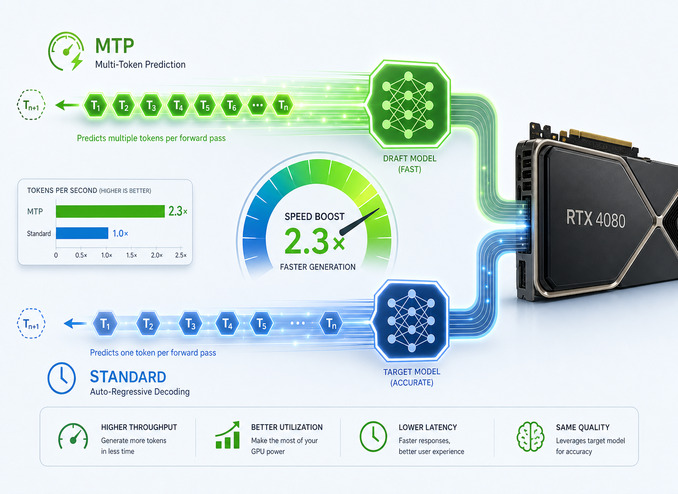
Multi-Token Prediction is a form of speculative decoding built directly into certain model checkpoints. Instead of predicting one token per forward pass, the model carries extra “MTP heads” that propose several future tokens in a single step — then verifies them in parallel. If the guesses are accepted, the effective throughput rises without changing the output quality.
The Qwen 3.6 family ships both standard GGUF files and MTP-enabled variants. In llama.cpp, MTP is activated through:
--spec-type draft-mtp --spec-draft-n-max 3
--spec-draft-n-max is the key tuning knob. It sets how many speculative tokens the MTP head proposes at each step. Higher values give a potential speed boost but cost extra VRAM for the draft buffers — a real constraint on 16 GB cards.
What and How I Tested
I tested how the two Qwen 3.6 models behave with MTP enabled versus standard decoding on a GPU with 16 GB VRAM (RTX 4080).
To fit model weights and KV cache into VRAM I used heavily quantised variants:
Qwen3.6-27B-UD-IQ3_XXSandQwen3.6-27B-UD-IQ3_XXS-MTPQwen3.6-35B-A3B-UD-IQ3_SandQwen3.6-35B-A3B-UD-IQ3_S-MTP
Two context budgets are tracked per run:
- Avg Ctx — the context size at which llama.cpp occupies ~14.8 GB VRAM, leaving other apps (Xorg, GNOME Shell, Cursor) a comfortable ~500 MB buffer.
- Max Ctx — the largest context llama.cpp could allocate given that the same desktop apps already hold ~500 MB VRAM.
A key reason for keeping the average context at a practical target is that Hermes Agent — which I use as the primary AI assistant connecting to llama.cpp on this machine — requires at least 64 K context by default and will reject models with a smaller window at startup. Models below that threshold cannot maintain enough working memory for multi-step tool-calling workflows. For llama.cpp this means passing --ctx-size 65536 or larger. Any MTP configuration that compresses the average usable context significantly below 64 K is therefore unsuitable for daily Hermes workloads, which is why the Avg Ctx numbers in the tables below are the most decision-relevant ones.
Both KV cache quantisation levels were tested: q8 (higher quality, more VRAM) and q5 (lower VRAM, longer context). Be aware that moving from q8 to q5 KV cache can cause a noticeable quality drop — in my testing the degradation was significant enough to make q5 unsuitable for my workloads. The speed and context numbers for q5 are included for completeness, but you should test response quality on your own tasks before committing to it.
Qwen 3.6 27B MTP vs Standard
KV Cache q8
| MTP max 1 | MTP max 2 | MTP max 3 | MTP max 4 | Standard (IQ3_XXS) | |
|---|---|---|---|---|---|
| Prompt Speed | 148 t/s | 151 t/s | 148 t/s | 147 t/s | 200 t/s |
| Gen Speed | 65 t/s | 75 t/s | 73 t/s | 75 t/s | 45 t/s |
| Avg Ctx | 40 K | 40 K | 40 K | 30 K | 80 K |
| Max Ctx | 60 K | 60 K | 60 K | 50 K | 100 K |
With q8 KV cache, MTP at --spec-draft-n-max 2 delivers ~67 % faster generation (75 vs 45 t/s) at the cost of halving the average context window from 80 K to 40 K. Prompt ingestion speed drops from 200 to ~150 t/s because MTP requires device-to-host transfers during the prefill phase.
KV Cache q5
| MTP max 1 | MTP max 2 | MTP max 3 | MTP max 4 | Standard (IQ3_XXS) | |
|---|---|---|---|---|---|
| Prompt Speed | 145 t/s | 144 t/s | 141 t/s | 139 t/s | 191 t/s |
| Gen Speed | 57 t/s | 62 t/s | 67 t/s | 66 t/s | 41 t/s |
| Avg Ctx | 70 K | 60 K | 60 K | 50 K | 130 K |
| Max Ctx | 100 K | 100 K | 90 K | 80 K | 160 K |
Switching to q5 KV cache recovers meaningful context: --spec-draft-n-max 1 gives 70 K average context at 57 t/s — a 39 % generation speedup over standard decoding while still keeping the context window at a useful size. At --spec-draft-n-max 3 the context drops to 60 K but generation reaches 67 t/s (+63 %).
Qwen 3.6 27B Takeaway
MTP is genuinely useful for the 27B dense model. The sweet spot on 16 GB VRAM is:
- q8 KV +
--spec-draft-n-max 2— best raw speed (75 t/s), context down to 40–60 K - q5 KV +
--spec-draft-n-max 1— best speed-vs-context balance (57 t/s, 70 K avg context)
Qwen 3.6 35B MTP vs Standard
The 35B model is a Mixture-of-Experts (MoE) architecture (35B-A3B means 35B total parameters, ~3B active per token). MoE models usually benefit more from MTP because the sparse routing keeps the MTP head computationally cheap relative to a full forward pass.
KV Cache q8
| MTP max 1 | MTP max 2 | MTP max 3 | MTP max 4 | Standard (IQ3_S) | |
|---|---|---|---|---|---|
| Prompt Speed | 277 t/s | 277 t/s | 265 t/s | 275 t/s | 368 t/s |
| Gen Speed | 186 t/s | 189 t/s | 180 t/s | 171 t/s | 146 t/s |
| Avg Ctx | 15 K | 10 K | — | — | 80 K |
| Max Ctx | 80 K | 70 K | 60 K | 50 K | 150 K |
The MoE architecture delivers impressive raw generation speed with MTP (+27 % at max 1, +29 % at max 2 vs standard 146 t/s). But the practical problem is the average context. With q8 KV cache, even --spec-draft-n-max 1 only gives 15 K average context — barely enough for modest tasks. Higher draft depths have no viable average context at all on a 16 GB card.
This is the central VRAM cost question for MTP on consumer hardware: the extra draft buffers eat into the remaining VRAM budget directly, and the 35B-A3B model with q8 KV cache leaves very little headroom.
KV Cache q5
| MTP max 1 | MTP max 2 | MTP max 3 | MTP max 4 | Standard (IQ3_S) | |
|---|---|---|---|---|---|
| Prompt Speed | 264 t/s | 266 t/s | 270 t/s | 264 t/s | 343 t/s |
| Gen Speed | 151 t/s | 147 t/s | 137 t/s | 131 t/s | 122 t/s |
| Avg Ctx | 10 K | — | — | — | 120 K |
| Max Ctx | 120 K | 110 K | 110 K | 80 K | 200 K |
q5 KV cache only marginally improves the average context story. --spec-draft-n-max 1 gives 10 K average context at 151 t/s. Standard decoding at q5 gives 122 t/s with 120 K average context.
Qwen 3.6 35B Takeaway
On a 16 GB GPU the 35B MoE model with MTP faces a hard wall: the average usable context collapses to 10–15 K tokens, making it impractical for real workloads. Standard decoding at 122–146 t/s with 80–120 K context is significantly more useful.
If you have 24 GB+ VRAM, the 35B + MTP combination becomes much more attractive — the context window issue disappears and you keep the speed benefit.
Choosing the Right --spec-draft-n-max Value
The question of how many speculative tokens to propose per step (--spec-draft-n-max) does not have a single right answer — it depends on both model architecture and available VRAM:
- For 27B dense on 16 GB:
--spec-draft-n-max 2with q8 KV is the fastest,--spec-draft-n-max 1with q5 KV is the most context-friendly. - For 35B MoE on 16 GB:
--spec-draft-n-max 1is the only option that keeps any usable context, and even then only marginally. - Higher values (
3,4) increase VRAM pressure without proportional speed gains — at max 4 you’re spending roughly the same extra VRAM as max 2 but gen speed doesn’t keep pace.
How to Enable MTP in llama.cpp
Make sure you use an MTP-enabled GGUF (the filename contains MTP). If you are new to llama.cpp flags, the llama.cpp Quickstart with CLI and Server covers all the fundamentals. Then launch llama-server or llama-cli with:
llama-server \
  --model Qwen3.6-27B-UD-IQ3_XXS-MTP.gguf \
  --ctx-size 40000 \
  -ngl 99 --flash-attn on \
  --cache-type-k q8_0 --cache-type-v q8_0 \
  --spec-type draft-mtp \
  --spec-draft-n-max 2
For q5 KV cache, replace q8_0 with q5_1 or q5_0 and adjust --ctx-size upward:
llama-server \
  --model Qwen3.6-27B-UD-IQ3_XXS-MTP.gguf \
  --ctx-size 80000 \
  -ngl 99 --flash-attn on \
  --cache-type-k q5_1 --cache-type-v q5_1 \
  --spec-type draft-mtp \
  --spec-draft-n-max 1
MTP is activated automatically once llama.cpp sees the MTP heads in the GGUF file and --spec-type draft-mtp is set.
So standard Qwen3.6-27B-UD-IQ3_XXS.gguf will not work in MTP mode, you will need Qwen3.6-27B-UD-IQ3_XXS-MTP.gguf.
But the Qwen3.6-27B-UD-IQ3_XXS-MTP.gguf can work in both Speculative decoding mode and autoregressive one.
Conclusion
On a 16 GB GPU (RTX 4080), with these quants, llama.cpp’s MTP is a clear win for Qwen 3.6 27B and a net negative for Qwen 3.6 35B in practical use:
Qwen 3.6 27B (IQ3_XXS) — MTP is worthwhile:
- q8 KV + MTP max 2 → ~67 % faster generation, context 40–60 K (vs 80–100 K without MTP)
- q5 KV + MTP max 1 → ~39 % faster generation, context 70–100 K (vs 130–160 K without MTP)
- Good balance of speed and VRAM efficiency at
--spec-draft-n-max 2
Qwen 3.6 35B (IQ3_S) — MTP is not practical at 16 GB:
- Generation speed is 27–29 % higher but average context collapses to 10–15 K at q8, 10 K at q5
- Standard decoding at 122–146 t/s with 80–120 K context is more useful for real tasks
- The situation improves substantially on 24 GB+ VRAM
On paper, q5 KV cache is the obvious answer for maximising context window while keeping MTP speed gains — but in practice the quality drop moving from q8 to q5 can be significant. Test q5 on your own tasks before adopting it; for my workloads the degradation was unacceptable, and q8 with a tighter context budget remains the better trade-off.
For the wider picture of LLM serving options and infrastructure trade-offs, see the LLM Hosting in 2026 pillar and LLM Performance in 2026. Where this 27B class sits on the 2026 size-and-cost spectrum, and why a current Qwen3.8-27B Q4 build wants a 24 GB card while the measurements above stay on 16 GB, is in The Efficient Frontier of Open Models in 2026. If you are tuning Qwen 3.6 sampler settings alongside MTP, the Agentic LLM Inference Parameters Reference for Qwen 3.6 and Gemma 4 is a useful companion.
