
Retrieval-Augmented Generation (RAG) Tutorial: Architecture, Implementation, and Production Guide
From basic RAG to production: chunking, vector search, reranking, and evaluation in one guide.
This Retrieval-Augmented Generation (RAG) tutorial is a step-by-step, production-focused guide to building real-world RAG systems.
If you are searching for:
- How to build a RAG system
- RAG architecture explained
- RAG tutorial with examples
- How to implement RAG with vector databases
- RAG with reranking
- RAG with web search
- Production RAG best practices
You are in the right place.
This guide consolidates practical RAG implementation knowledge, architectural patterns, and optimization techniques used in production AI systems.

RAG Cluster Map (Read This in Order)
If you want the fastest path through the RAG cluster, use this map:
- You are here: RAG overview + end-to-end pipeline (this page)
- Chunking (retrieval quality foundation): Chunking Strategies in RAG
- Text embeddings (APIs and Python): Text embeddings for RAG and search — Ollama and OpenAI-compatible embedding endpoints, retrieval shape, links onward
- Vector stores (storage + indexing choices): Vector Stores for RAG Comparison
- Retrieval depth (when “search” isn’t enough): Search vs DeepSearch vs Deep Research
- Reranking (often the biggest quality gain): Reranking with Embedding Models
- Embeddings + reranker models (practical implementations):
- Advanced architectures: Advanced RAG Variants: LongRAG, Self-RAG, GraphRAG
- Graph + vector retrieval (GraphRAG on a graph database): Neo4j graph database for GraphRAG, install, Cypher, vectors, ops — property graphs, vector indexes, and neo4j-graphrag in one place
What Is Retrieval-Augmented Generation (RAG)?
Retrieval-Augmented Generation (RAG) is a system design pattern that combines:
- Information retrieval
- Context augmentation
- Large language model generation
In simple terms, a RAG pipeline retrieves relevant documents and injects them into the prompt before the model generates an answer.
Unlike fine-tuning, RAG:
- Works with frequently updated data
- Supports private knowledge bases
- Reduces hallucination
- Avoids retraining large models
- Improves answer grounding
Modern RAG systems include more than vector search. A complete RAG implementation may include:
- Query rewriting
- Hybrid search (BM25 + vector search)
- Cross-encoder reranking
- Multi-stage retrieval
- Web search integration
- Evaluation and monitoring
Minimal Production RAG Blueprint (Reference Implementation)
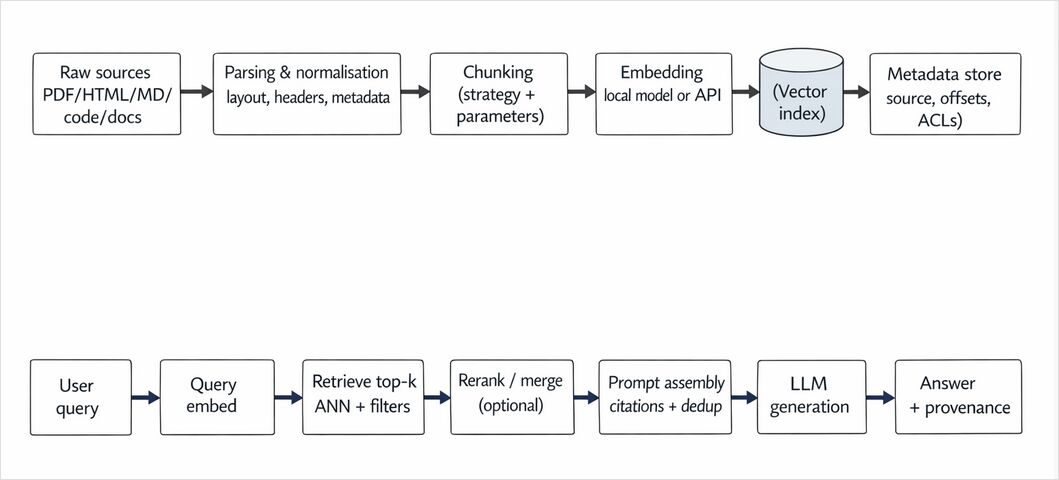
Use this as a mental model (and a starting skeleton) for production RAG.
Ingestion pipeline (offline or continuous)
- Collect sources (docs, tickets, web pages, PDFs, code)
- Normalize (extract text, clean boilerplate, de-duplicate)
- Chunk (choose strategy + overlap + metadata)
- Embed (versioned embeddings)
- Upsert into index (vector store + metadata fields)
- Reindex strategy when embeddings or chunking change
Query pipeline (online)
- Parse / rewrite query (optional)
- Retrieve candidates (vector or hybrid + metadata filtering)
- Rerank top-K with a cross-encoder / reranker model
- Assemble context (dedupe, order by relevance, add citations)
- Generate with grounded prompt (rules + refusal behavior)
- Log (retrieval set, reranked set, final context, latency, cost)
- Evaluate (online/offline harness)
If you only improve one thing in a working RAG system: add reranking and an evaluation harness.
Step-by-Step RAG Tutorial: How to Build a RAG System
This section outlines a practical RAG tutorial flow for developers.
Step 1: Prepare and Chunk Your Data
Retrieval quality depends heavily on chunking strategy and indexing design: good RAG starts with proper chunking.
Chunking determines:
- Retrieval recall
- Latency
- Context noise
- Token cost
- Hallucination risk
Common RAG chunking strategies include:
- Fixed-size chunking
- Sliding window chunking
- Semantic chunking
- Recursive chunking
- Hierarchical chunking
- Metadata-aware chunking
Poor chunking is one of the most common causes of underperforming RAG systems.
For a rigorous, engineering-first deep dive into chunking trade-offs, evaluation dimensions, decision matrices, and runnable Python implementations, see:
Chunking Strategies in RAG: Alternatives, Trade-offs, and Examples
That guide covers practical defaults for:
- QA systems
- Summarisation pipelines
- Code search
- Multimodal documents
- Streaming ingestion
- Multimodal documents with cross-modal embeddings
If you are serious about RAG performance, read that before tuning embeddings or reranking.
For multimodal RAG systems that bridge text, images, and other modalities, explore Cross-Modal Embeddings: Bridging AI Modalities
Step 2: Choose a Vector Database for RAG
A vector database stores embeddings for fast similarity search.
Compare vector databases here:
Vector Stores for RAG - Comparison
When selecting a vector database for a RAG tutorial or production system, consider:
- Index type (HNSW, IVF, etc.)
- Filtering support
- Deployment model (cloud vs self-hosted)
- Query latency
- Horizontal scalability
- Multi-tenancy and access control requirements
Step 3: Implement Retrieval (Vector Search or Hybrid Search)
Basic RAG retrieval uses embedding similarity.
Advanced RAG retrieval uses:
- Hybrid search (vector + keyword)
- Metadata filtering
- Multi-index retrieval
- Query rewriting
For conceptual grounding:
Search vs DeepSearch vs Deep Research
Understanding retrieval depth is essential for high-quality RAG pipelines.
Step 4: Add Reranking to Your RAG Pipeline
Reranking is often the biggest quality improvement in a RAG implementation.
Reranking improves:
- Precision
- Context relevance
- Faithfulness
- Signal-to-noise ratio
Learn reranking techniques:
- Reranking with Embedding Models
- Qwen3 Embedding + Qwen3 Reranker on Ollama
- Reranking with Ollama + Qwen3 Embedding (Go)
- Reranking with Ollama + Qwen3 Reranker in Go
In production RAG systems, reranking often matters more than switching to a larger model.
Step 5: Integrate Web Search (Optional but Powerful)
Web search augmented RAG enables dynamic knowledge retrieval.
Web search is useful for:
- Real-time data
- News-aware AI assistants
- Competitive intelligence
- Open-domain question answering
See practical implementations:
Step 6: Build a RAG Evaluation Framework
A serious RAG tutorial must include evaluation. Without it, optimizing a RAG system becomes guesswork.
What to measure
| Layer | What to measure | Why it matters |
|---|---|---|
| Ingestion | chunk coverage, duplicate rate, embedding version | prevents silent drift |
| Retrieval | recall@k, precision@k, MRR/NDCG | tells you if you’re fetching the right evidence |
| Reranking | delta in precision@k vs baseline | validates reranker ROI |
| Generation | faithfulness / groundedness, citation accuracy, refusal quality | reduces hallucination |
| System | latency p50/p95, cost per query, cache hit rate | keeps prod usable |
Minimal evaluation harness (practical checklist)
- Build a test set of queries (real user queries if possible)
- For each query, store:
- expected answer or expected sources
- allowed sources (gold documents) when available
- Run an offline batch:
- retrieve candidates
- rerank
- generate
- score (retrieval + generation)
- Track metrics over time and fail the build on regressions (even small ones)
Start simple: 50–200 queries is enough to detect major regressions.
Advanced RAG Architectures
Once you understand basic RAG, explore advanced patterns:
Advanced RAG Variants: LongRAG, Self-RAG, GraphRAG
Advanced Retrieval-Augmented Generation architectures enable:
- Multi-hop reasoning
- Graph-based retrieval
- Self-correcting loops
- Structured knowledge integration
For GraphRAG and knowledge-graph retrieval where you combine graph traversal with vector similarity in one system, see Neo4j graph database for GraphRAG, install, Cypher, vectors, ops (install, Cypher, vector indexes, hybrid retrieval, and the neo4j-graphrag Python package).
These architectures are essential for enterprise-grade AI systems.
When RAG Fails (And How to Fix It)
Most RAG failures are diagnosable if you look at the pipeline layer-by-layer.
- It returns irrelevant context → improve chunking, add metadata filters, implement hybrid search, tune K.
- It retrieves the right docs but answers incorrectly → add reranking, reduce context noise, improve prompt grounding rules.
- It hallucinates despite good docs → enforce citations, add refusal behavior, add faithfulness scoring, reduce “creative” temperature.
- It’s slow/expensive → cache retrieval + embeddings, reduce rerank K, limit context, batch embeds, tune ANN index parameters.
- It leaks data across tenants → implement ACL filtering at retrieval time (not only in prompt), separate indexes or per-tenant partitions.
Common RAG Implementation Mistakes
Common mistakes in beginner RAG tutorials include:
- Using overly large document chunks
- Skipping reranking
- Overloading the context window
- Not filtering metadata
- No evaluation harness
Fixing these dramatically improves RAG system performance.
RAG vs Fine-Tuning
In many tutorials, RAG and fine-tuning are confused. Use this decision guide:
| You should prefer… | When… |
|---|---|
| RAG | knowledge changes frequently; you need citations/auditability; you have private documents; you want fast updates without retraining |
| Fine-tuning | you need consistent tone/behavior; you want the model to follow a domain style guide; your knowledge is relatively static |
| Both | you need domain behavior and fresh/private knowledge (common in production) |
Use RAG for:
- External knowledge retrieval
- Frequently updated data
- Lower operational risk
Use fine-tuning for:
- Behavioral control
- Tone/style consistency
- Domain adaptation when data is static
Most advanced AI systems combine Retrieval-Augmented Generation with selective fine-tuning.
Production RAG Best Practices
If you are moving beyond a RAG tutorial into production:
Retrieval + quality
- Use hybrid retrieval
- Add reranking
- Use metadata filtering and deduplication
- Track retrieval metrics (recall@k / precision@k) continuously
Cost + latency (don’t skip this)
- Cache:
- Embedding cache (identical text → identical embedding)
- Retrieval cache (popular queries)
- Response cache (for deterministic workflows)
- Tune ANN index parameters (HNSW/IVF) and batch operations
- Control token usage: smaller context, fewer candidates, structured prompts
Security + privacy
- Do access control at retrieval time (ACL filters / per-tenant partitions)
- Redact or avoid indexing PII where possible
- Log safely (avoid storing raw sensitive prompts unless required)
Operational discipline
- Version your embeddings and chunking strategy
- Automate ingestion pipelines
- Monitor hallucination/faithfulness metrics
- Track cost per query
Retrieval-Augmented Generation is not just a tutorial concept - it is a production architecture discipline.
Final Thoughts
This RAG tutorial covers both beginner implementation and advanced system design.
Retrieval-Augmented Generation is the backbone of modern AI applications.
Mastering RAG architecture, reranking, vector databases, hybrid search, and evaluation will determine whether your AI system remains a demo - or becomes production-ready.
This topic will continue expanding as RAG systems evolve.
