Chunking is the most under-estimated hyperparameter in Retrieval ‑ Augmented Generation (RAG):
it silently determines what your LLM “sees”,
how expensive ingestion becomes,
and how much of the LLM’s context window you burn per answer.
From basic RAG to production: chunking, vector search, reranking, and evaluation in one guide.
Production-focused guide to building RAG systems: chunking, vector stores, hybrid retrieval, reranking, evaluation, and when to choose RAG over fine-tuning.
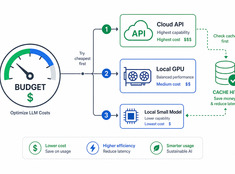
Strategic guide to hosting large language models locally with Ollama, llama.cpp, vLLM, or in the cloud. Compare tools, performance trade-offs, and cost considerations.
Running large language models locally gives you privacy, offline capability, and zero API costs.
This benchmark reveals exactly what one can expect from 14 popular
LLMs on Ollama on an RTX 4080.
The Rust ecosystem is exploding with innovative projects, particularly in AI coding tools and terminal applications.
This overview analyzes the top trending Rust repositories on GitHub this month.
The Go ecosystem continues to thrive with innovative projects spanning AI tooling, self-hosted applications, and developer infrastructure. This overview analyzes the top trending Go repositories on GitHub this month.
This comprehensive guide provides background and a detailed comparison of Anaconda, Miniconda, and Mamba - three powerful tools that have become essential for Python developers and data scientists working with complex dependencies and scientific computing environments.
Melbourne’s tech community continues to thrive in 2026 with an impressive lineup of conferences, meetups, and workshops spanning software development, cloud computing, AI, cybersecurity, and emerging technologies.
vLLM is a high-throughput, memory-efficient inference and serving engine for Large Language Models (LLMs) developed by UC Berkeley’s Sky Computing Lab.
The proliferation of AI-generated content has created a new challenge: distinguishing genuine human writing from “AI slop” - low-quality, mass-produced synthetic text.
When working with Large Language Models in production, getting structured, type-safe outputs is critical.
Two popular frameworks - BAML and Instructor - take different approaches to solving this problem.