Building REST APIs in Go: Complete Guide
Build production-ready REST APIs with Go's robust ecosystem
Building high-performance REST APIs with Go has become a standard approach for powering systems at Google, Uber, Dropbox, and countless startups.
Build production-ready REST APIs with Go's robust ecosystem
Building high-performance REST APIs with Go has become a standard approach for powering systems at Google, Uber, Dropbox, and countless startups.
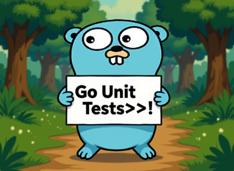
Go testing from basics to advanced patterns
Go’s built-in testing package provides a powerful, minimalist framework for writing unit tests without external dependencies. Here are the testing fundamentals, project structure, and advanced patterns to build reliable Go applications.
Transactions in Microservices with Saga pattern
The Saga pattern provides an elegant solution by breaking distributed transactions into a series of local transactions with compensating actions.
Type-safe reusable code with Go generics
Generics in Go represent one of the most significant language features added since Go 1.0. Introduced in Go 1.18, generics enable you to write type-safe, reusable code that works with multiple types without sacrificing performance or code clarity.
CLI development in Go with Cobra and Viper frameworks
Command-line interface (CLI) applications are essential tools for developers, system administrators, and DevOps professionals. Two Go libraries have become the de facto standard for CLI development in Go: Cobra for command structure and Viper for configuration management.
Create consistent, portable, and reproducible development environments using Dev Containers
Developers often face the “works on my machine” dilemma due to dependency mismatches, tool versions, or OS differences. Dev Containers in Visual Studio Code (VS Code) solve this elegantly — by letting you develop inside a containerized environment configured specifically for your project.
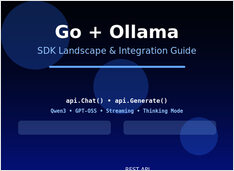
Integrate Ollama with Go: SDK guide, examples, and production best practices.
This guide provides a comprehensive overview of available Go SDKs for Ollama and compares their feature sets.
A couple of ways to get structured output from Ollama
Large Language Models (LLMs) are powerful, but in production we rarely want free-form paragraphs. Instead, we want predictable data: attributes, facts, or structured objects you can feed into an app. That’s LLM Structured Output.
A practical, code-heavy look on ORMs in GO
Most prominent ORMs for GO are GORM, Ent, Bun and sqlc. Here is a little comparison of them with examples of CRUD operations in pure GO.
Longread about MCP scpecs and implementation in GO
Here we have a description of The Model Context Protocol (MCP), short notes on how to implement an MCP server in Go, including message structure, protocol specifications.
Implementing RAG? Here are some Go code bits - 2...
Since standard Ollama doesn’t have a direct rerank API, you’ll need to implement reranking using Qwen3 Reranker in GO by generating embeddings for query-document pairs and scoring them.
Implementing RAG? Here are some codesnippets in Golang..
This little Reranking Go code example is calling Ollama to generate embeddings for the query and for eache candidate document, then sorting descending by cosine similarity.
OK. Now generating PDFs in GO!
Generating PDF documents programmatically can be an important feature in your application. Here we explore and give short review with examples of the libraries available in the Go programming language (Golang) for generating PDF files.
Continuing the topic of extracting data from html
If you’re looking for a Beautiful Soup equivalent in Go, several libraries offer similar HTML parsing and scraping functionality:
With the release of new pg driver AutoMigrate is throwing errors...
In my new Go project that was using GORM I started getting error:
pq: got 2 parameters but the statement requires 1
Based on VS Code extentions install count
I aggregated some VS Code extentions installation statistics by different programming languages. And the most popular is Python. Then C++.